 SpecFit
Glasses for a narrow face
A narrow face is slim from temple to temple. Many narrow faces are long or oval, not small.

Is your face narrow?
Measure your face from temple to temple. That is where the arms of your glasses pass.
- Under 130 mm: a narrow face.
- 130 to 140 mm: a medium face. Most frames are made for this.
- Over 140 mm: a wide face.
Your glasses give clues too. They stick out past your face, or slide down your nose.
Narrow face or small face?
- Small face: short and narrow. The whole face is small.
- Narrow face: slim at the sides. But it can be of normal length, or long.
Both need a narrow frame. A long, narrow face also needs a deeper lens.
Short and narrow? Read glasses for small faces.
Not sure of your face width? The SpecFit app measures it.
Download SpecFitThe frame width to look for
Width is the most important number. Get it right first.
- Total width: 126 to 132 mm for most narrow faces.
- Close to your face: within 2 to 3 mm of your face width.
- Lens width: often 46 to 50 mm.
- A pair you own: if it fits well, copy its numbers.
No total width on the page? Add two lens widths, the bridge and about 12 mm.
See how wide glasses should be and the glasses size chart.
The bridge and nose pads
Many narrow faces also have a narrow nose bridge. A wide bridge lets the frame drop.
- Narrow bridge: try 14 to 17 mm first.
- Nose pads: small pads on metal arms. They grip a narrow nose.
- Pads you can bend: an optician can shape them to your nose.

Still sliding? See why glasses slip down your nose.
Shapes that add width
You want a frame that makes the face look a bit wider. On a long face, it should also break up the length.
- Browline: a strong top bar runs across the face.
- Round or oval with depth: soft curves add width. A deeper lens covers more of a long face.
- Wider-looking corners: a slight lift or bold outer corners pull the eye out.
- Bold arms: colour or detail on the arms adds width at the sides.
- Low-set arms: arms that join low on the frame make the face look shorter.



In each one, the frame ends close to the sides of the face. More ideas for a long face are in glasses for a long face.
What to avoid
- Frames past your face: they look too big and slide down.
- Narrow, shallow rectangles: on a long, narrow face, they make it look longer.
- Big, heavy frames: thick rims and wide hinges add width past your face.
- A wide bridge: the frame sits low on your nose.


A real case is in glasses too big for your face.
Check the arm length
A narrow face does not always need short arms. Arm length depends on how far back your ears are.
- Too long: the bend is past your ear. The frame slips.
- Too short: the arms press behind your ears.
- Just right: the bend starts at the top of your ear.

Arm length is the last number on the frame, often 135 to 145 mm. See how temple arms should fit.
How SpecFit helps
SpecFit is a free iPhone app. It scans your face with the Face ID camera.
- Face width: measured temple to temple, in real mm.
- Face shape: the scan tells you if your face is long or oval.
- Fit check: paste a link to any pair. It scores the width against your face.
- Try-on: see the frame on your own photo. A render costs one credit.
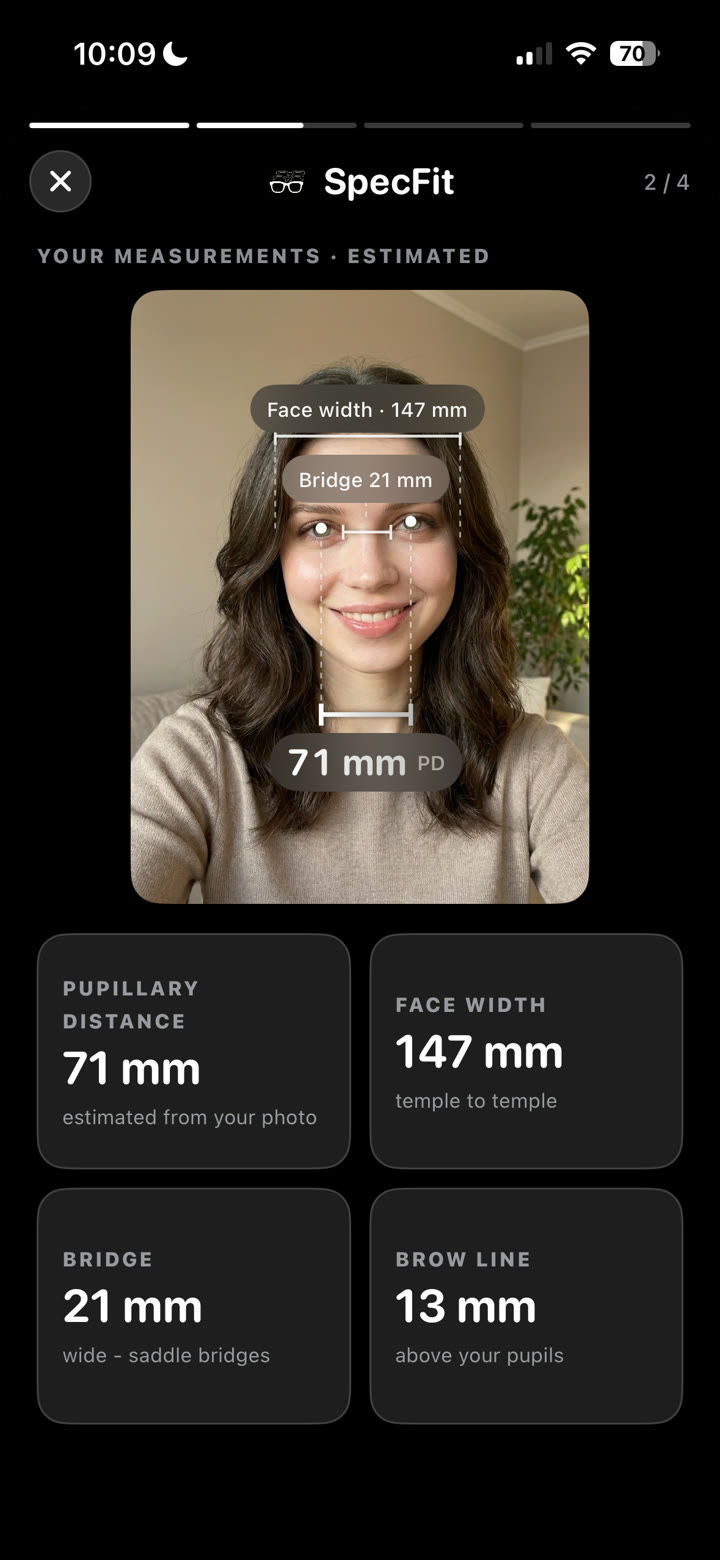
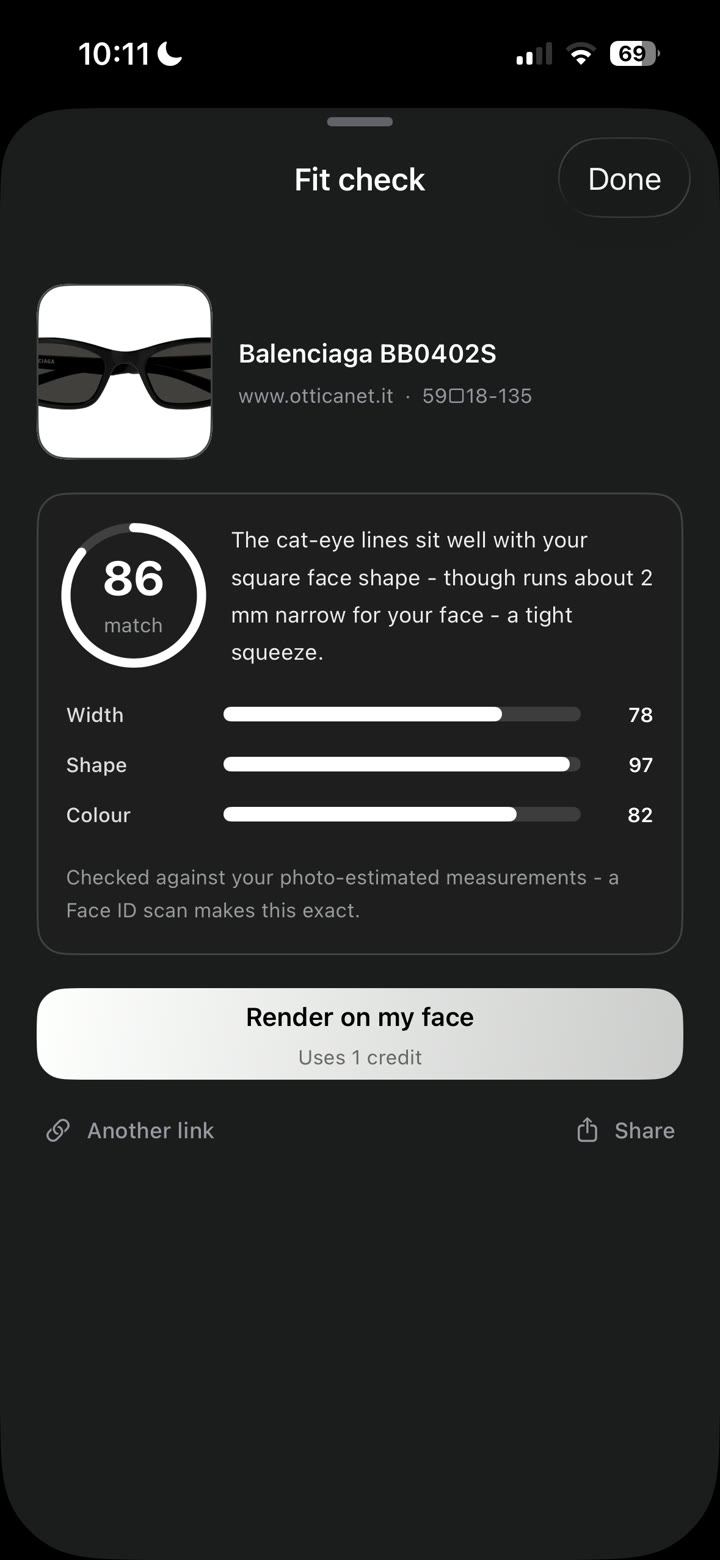
One quick scan on a Face ID iPhone. Then check the width of any pair and try it on your photo.
Download SpecFitQuestions
What glasses suit a narrow face?
Frames about as wide as your face, often 126 to 132 mm. A browline, or a round or oval lens with some depth, works well.
Is a narrow face the same as a small face?
No. A small face is short and narrow. A narrow face can be normal length, or long.
What face width counts as narrow?
Under about 130 mm, temple to temple. Most frames are made for 130 to 140 mm.
Why do glasses slide down my narrow face?
The frame or the bridge is often too wide. Try a narrower frame, a narrow bridge or nose pads.