 SpecFit
Are PD measurement apps accurate?
The short answer: it depends entirely on which kind of app you use. Apps that measure with a depth camera are accurate to about a millimetre. Apps that guess your scale from a flat photo are not.
Why a plain photo cannot measure
A camera does not measure distance from a single flat photo. It only records light. A 2D photo has no built-in scale.
Think about what that means in practice. A face 60 cm from the camera and a larger face 75 cm away can produce the same image. The pupils look the same width apart in the picture. The real distance between them is not the same at all. The camera cannot tell the two cases apart from pixels alone.
So any app that works from one plain photo has to borrow its scale from somewhere else. It might use an object of known size, like a credit card held next to your face. It might assume an average head width and apply a standard ratio. Either way, the result is a guess dressed up as a measurement. Its quality depends entirely on how good that guess is.
The three ways apps get a number
Every phone PD tool falls into one of three categories. The method decides the accuracy, not how polished the app looks.
| Method | How it gets scale | Typical accuracy |
|---|---|---|
| Depth-camera scan (TrueDepth on Face ID iPhones) | Measures the face in three dimensions, in real millimetres. No reference object needed. | About ±1 mm |
| Photo plus a reference card | Borrows scale from the card's known width, usually a credit card held to the forehead | Typically 2 mm or more of error |
| Mirror and ruler by hand | Your own reading of a ruler held to your face in a mirror | About ±2-3 mm with care |
The card method loses accuracy because the card is not where your eyes are. It sits forward of the eye plane, and it tilts. A small tilt changes how large the card appears in the photo, and the app's scale shifts with it. That is why the error runs to 2 mm or more even when the app itself is well built.
The mirror-and-ruler method has its own problem: it is fiddly. Reading a ruler at an angle, in a mirror, while trying to line it up with both eyes takes practice. With care, most people land within about 2 to 3 mm.
An optician's pupillometer remains the gold standard. It is built for one job, calibrated for it, and used by someone trained to hold it steady. No phone app claims to beat it. The best a depth scan can do is come close.
When accuracy matters
Not every error matters the same amount. For a mild single-vision prescription, an error of 1 to 2 mm is usually too small to notice. Your eyes and brain adjust to it.
Strong prescriptions are less forgiving. A lens centred slightly off from your pupil bends light where you did not intend. Opticians call that induced prism, and it causes eye strain. Progressive lenses raise the stakes further, since a progressive stacks three zones, distance, middle range and reading, into one piece of glass. All three zones must line up with your eyes at once, so a small centring error puts every zone slightly wrong.
For those two cases, a strong prescription and any progressive lens, use a depth scan, or ask your optician for the number they measured.
It helps to sanity check a result against the normal range. Most adults measure between 57 and 65 mm. The full adult range runs from roughly 54 to 74 mm, so a result far outside that is worth remeasuring. One more detail worth knowing: your near PD, used for reading glasses, is usually about 3 mm smaller than your distance PD, because your eyes converge slightly to focus up close.
How SpecFit does it
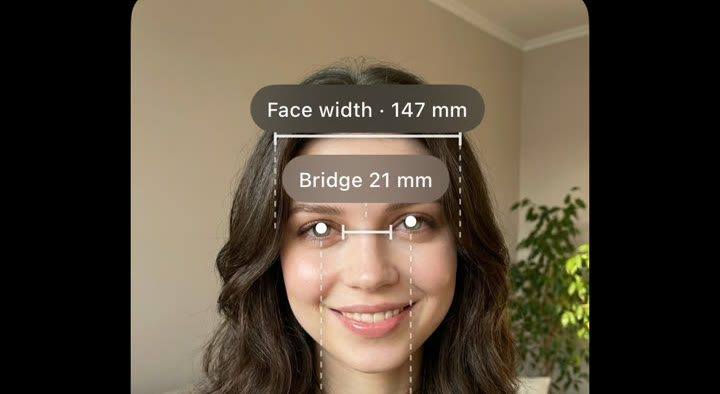
SpecFit measures with the TrueDepth camera built into Face ID iPhones. That camera reads your face in three dimensions and reports the result in real millimetres, with no card and no guesswork. SpecFit draws the measurement directly onto your own photo, so you can see exactly what was measured and where. On that hardware, the result is accurate to about ±1 mm.
Not every iPhone has a TrueDepth camera. On phones without Face ID, SpecFit falls back to a single-photo estimate, and it labels that result honestly as an estimate, not a measurement.
Either way, it is worth being clear about what this is. It is an estimate, not a medical measurement, and it does not replace an optician's exam. The measurement itself is free.
SpecFit measures your PD with the iPhone depth camera. Point a Face ID iPhone at your face and SpecFit reads it with a depth scan, accurate to about a millimetre, drawn on your own photo. Free to check.

Questions
Is a phone PD measurement good enough to order glasses online?
For a mild single-vision prescription, yes. For strong prescriptions and progressive lenses, use a depth scan or ask your optician for the number they measured.
Which is more accurate, an app or a ruler?
A depth-camera app beats a ruler. A photo-only app that uses a reference card is roughly comparable to a careful ruler measurement.
Do I need a dual PD?
Two per-eye numbers matter most when your face is asymmetric or your prescription is strong. A depth scan can read each eye separately.
Can I reuse the PD from my old prescription?
Yes. Adult PD does not change. If an optician measured it, that number is still good.