 SpecFit
Is your PD on your glasses prescription?
Sometimes. PD (pupillary distance) is the distance between the centres of your pupils, in millimetres. Many prescriptions leave it out entirely, even though every online optician asks for it. Here is where to look, what the numbers mean if you find them, and what to do if you cannot.
Why it is often missing
A prescription states your lens power: how strong the correction is, and in which direction. PD is different. It states where to put that correction on your face, so the lens maker cuts each lens with its optical centre in front of your pupil. Because PD is a fitting measurement rather than a power, in many places opticians are not required to write it on the prescription. Some treat measuring PD as part of the dispensing service they sell you, along with the frame, rather than as part of the eye test, and leave it off the paper you take home.
That does not mean the number was never measured. It usually means it was not written down for you to keep.
Where to look if it is there
Check for a box or line labelled PD, Pupillary distance, or Dist. PD. It is easy to miss, since it often sits in a small box at the bottom or side of the form, apart from the main table of numbers.
The other boxes on a prescription describe lens power, not PD, so use this to tell them apart.
| Label | What it means |
|---|---|
| SPH (sphere) | The main lens power, for short-sightedness or long-sightedness |
| CYL (cylinder) | Correction for astigmatism |
| AXIS | The angle of that astigmatism correction |
| ADD | Extra reading power, for bifocal or progressive lenses |
| OD/OS or R/L | Right eye and left eye |
None of those is PD. If you see only those, your PD was not recorded on the form.
What the PD number itself looks like
When PD is present, it appears in one of three formats.
| What you see on the prescription | What it means |
|---|---|
| 63 | A single binocular PD: the total distance between your pupil centres, 63 mm. |
| 31.5 / 31.5 | A monocular PD: the distance from the bridge of your nose to each pupil. The two numbers add up to your binocular PD, here 63 mm. |
| 63 / 60 | Distance PD and near PD. The near number is smaller, usually by about 3 mm, because your eyes converge slightly to focus up close. |
| PD blank or missing | Not recorded on this form. Ask the optician who tested you, or measure it yourself. |
Most adults fall between 54 and 74 mm, and a value close to 63 is common. If a number on your prescription sits well outside that range, check that you are reading the right box before you use it.
What to do if it is missing
You have two options. First, ask the optician who tested you for the number they measured. In many places you are entitled to it, though the rule varies by country, so a polite request is worth trying before you assume you have to pay again or measure it yourself.
Second, measure it yourself. A few home methods work well enough for most prescriptions.
- An iPhone depth scan, accurate to about ±1 mm.
- A mirror and a ruler, accurate to about ±2 to 3 mm.
- A friend and a ruler, accurate to about ±2 mm.
We cover all three methods, step by step, in how to measure your PD at home.
Why the number matters
Lenses are cut so the optical centre of each lens sits directly in front of your pupil. Get PD wrong by more than about 2 mm and you look through the wrong part of the lens, which causes eye strain. It matters more for strong prescriptions and for progressive lenses, where a small error is magnified or affects several zones of the lens at once. See are PD measurement apps accurate for how much each measurement method typically errs by.
One piece of good news: PD does not change once you are an adult. If an optician measured it correctly for a previous pair of glasses, you can reuse that number without measuring again.
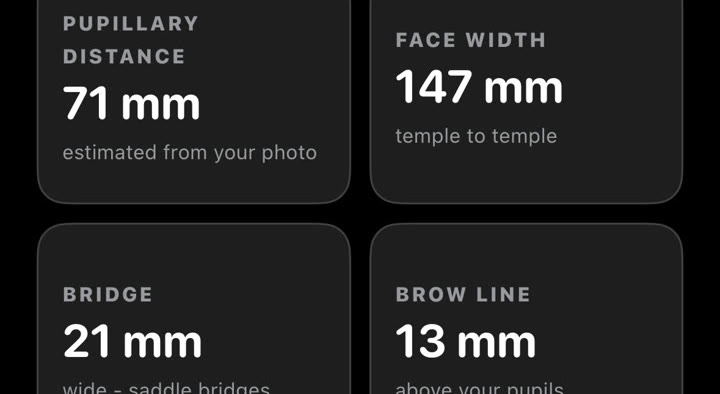
SpecFit measures your PD free. One guided scan on a Face ID iPhone, accurate to about ±1 mm, drawn on your own photo. Paste a link to any glasses and the same app reads the size stamp and scores the fit against your face, free to check. Rendering a frame on your face costs one credit.

Questions
Why is PD not on my prescription?
A prescription states lens power. PD is a fitting measurement, not a power, so in many places opticians are not required to write it, and some leave it off.
What does PD 63 mean?
Your pupillary distance is 63 mm, a single binocular number rather than a per-eye reading. It is close to average for an adult.
What if my prescription shows two PD numbers?
If labelled left and right, each is nose to pupil, and they add up to your binocular PD. If labelled distance and near, the near number is smaller, since your eyes converge to read.
Am I entitled to my PD if it is missing?
In many places, yes, though it varies by country. Ask the optician who tested you, or measure it yourself at home instead.