 SpecFit
What happens if your PD is wrong?
PD means pupillary distance, the gap between your pupils in mm. If it is wrong, you look through the wrong part of each lens.
What does PD mean on glasses?
PD is short for pupillary distance. It runs from pupil centre to pupil centre.
Most adults have a PD of 54 to 74 mm. Many sit near 63 mm.
Each lens has one best spot, the optical centre. The lab sets it in front of each pupil.
Single PD or dual PD?
- Single PD: one number, like 63. It runs from pupil to pupil.
- Dual PD: two numbers, like 31/32. Each runs from the middle of your nose to one pupil.
- Which is better: dual PD is more exact. Most faces are a bit uneven.
- How to read it: right eye first, then left. The two add up to your single PD.
Distance PD or near PD?
- Distance PD: for far vision, TV and driving. Most shops ask for this one.
- Near PD: for reading glasses. It is often about 3 mm smaller.
- Why it is smaller: up close, your eyes turn in a bit.
What happens if your PD is wrong?
Light goes straight through the centre of a lens. Away from the centre, the lens bends it.
If the centre is off your pupil, light comes in at a slant. This is called induced prism.
Your eyes turn a little to keep one clear picture. Doing this all day is tiring.
How many mm off is OK?
The stronger the lens, the more a small error bends the light.
| Lens power | 1 mm off | 2 mm off | 4 mm off |
|---|---|---|---|
| Weak (1.00) | 0.1 | 0.2 | 0.4 |
| Mid (3.00) | 0.3 | 0.6 | 1.2 |
| Strong (6.00) | 0.6 | 1.2 | 2.4 |
Numbers are prism per lens. Labs allow about 0.67 in total.
- Most prescriptions: 1 to 2 mm off is usually fine.
- Weak lenses: a few mm off may not be felt at all.
- Strong lenses: over about 4.00, aim for 1 mm or less.
- Progressives: use dual PD. The reading zone is narrow.
- Prism on your form: have an optician make and fit these.
Why progressives need more care
A progressive lens has a narrow path for near and mid vision. Your PD places that path.
If the PD is off, the path sits to one side. You may need to turn your head to read.
See best frames for progressives and minimum lens height.
Wrong PD symptoms checklist
- Tired eyes: they ache after an hour or two.
- Headaches: often at the brow or temples, late in the day.
- Blur: things look soft, even though the power is right.
- Double vision: you see two of things, mostly far away.
- A pulling feeling: your eyes feel drawn in or out.
- Feeling off: steps or stairs feel a bit strange.
- Better with one eye: closing one eye makes it easier.
- Small reading zone: with progressives, you turn your head a lot.
These signs can have other causes too. The power may be off, or the frame may sit wrong.
New glasses can take a few days to get used to. Double vision is not normal, so get it checked soon.
How to check your PD
The easy way is SpecFit, a free iPhone app.
- Free: the PD scan costs nothing.
- About 1 mm: the Face ID depth camera measures in real mm.
- Under a minute: one guided scan. You just turn your head slowly.
- On your own photo: it draws the PD line on your face.
- Ready to use: you get a single PD, the number most shops ask for.
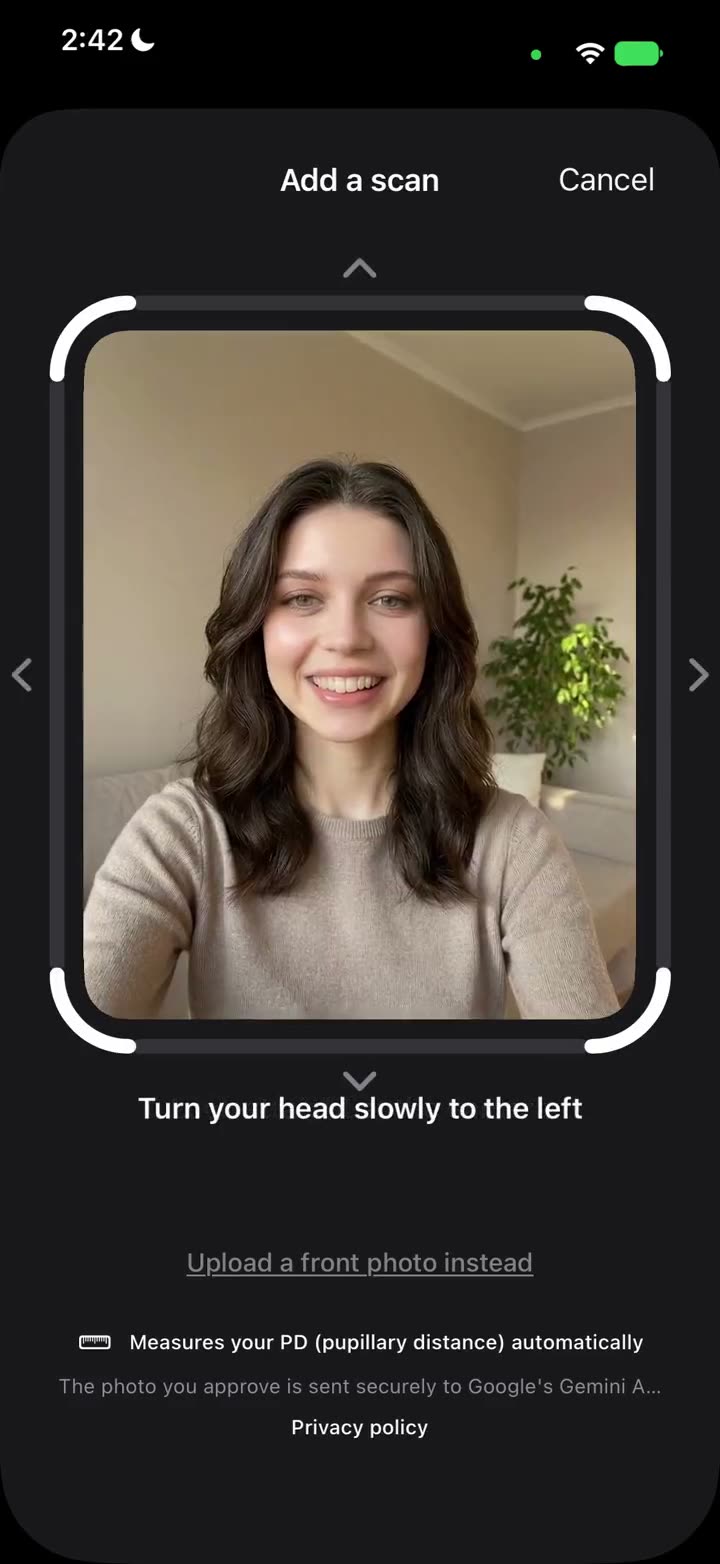
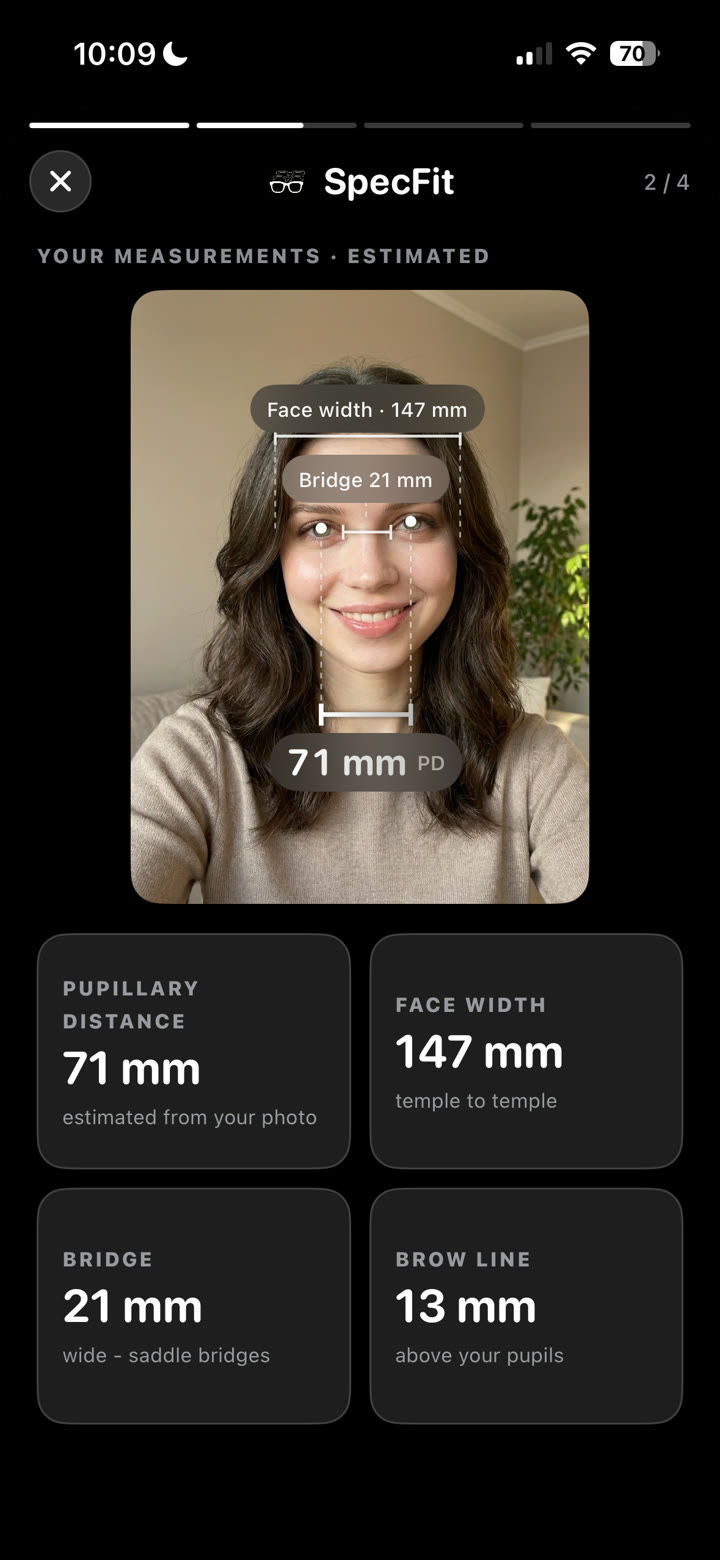
No Face ID? SpecFit can estimate PD from one selfie, labelled as an estimate.
SpecFit does not replace an eye exam. Other ways to check:
- Your prescription: look for PD or Dist PD. Often it is not on the form.
- Your optician: ask. They can measure it in a minute.
- Ruler and mirror: good to about 2 to 3 mm. See measure your PD at home.
- A friend and a ruler: good to about 2 mm, with care.
- Dual PD: for progressives, ask your optician for one number per eye.
What to do if new glasses feel wrong
- Give it a few days: mild strain often fades as you adjust.
- Go back soon: take the glasses to the shop that made them.
- Ask for a check: they can compare the lens centres to your PD.
- Check the fit: a crooked frame moves the centres too. See how glasses should fit.
- Ask for a remake: most shops redo lenses made to the wrong PD.
- See an eye doctor: if signs last with correct lenses.
One guided scan on a Face ID iPhone. It is free, and it draws the result on your own photo.
Download SpecFitQuestions
What does PD mean for glasses?
PD means pupillary distance. It is the gap between your pupils, in mm.
What if my PD is off by 1 mm?
For most people, nothing. A 1 mm error is within normal lab limits.
Is a PD off by 2 mm too much?
Not for most lenses. With strong lenses or progressives, ask your optician to check.
What does Dist PD mean?
It means distance PD. It is the PD for far vision, and the one most shops ask for.
Is single or dual PD better?
Dual PD is more exact. Use it if you have it, most of all for progressives.